

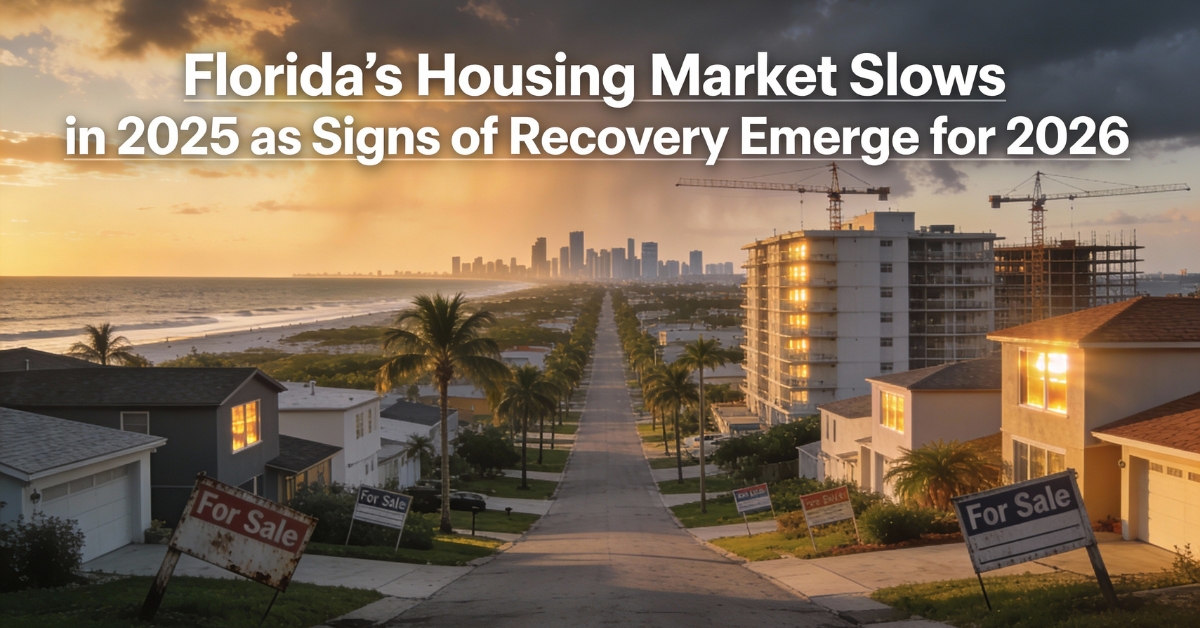

Florida’s housing market has always been a bellwether for national real estate trends. Fueled by migration, tourism, and international demand, the Sunshine State has enjoyed years of rapid growth. In 2025, however, the pace clearly slowed. Prices softened, inventory levels rose, and buyers gained negotiating power across many markets. Yet, beneath this cooling trend, early signs point toward renewed momentum in 2026.
According to Florida Realtors, the state’s largest real estate trade association, 2025 marked a year of market recalibration rather than decline. Moderating mortgage rates, steady population growth, and a rebound in international buyer activity are laying the foundation for a more balanced and sustainable housing market in the year ahead.
A Market That Took a Breather in 2025
After several years of intense competition, rapid price appreciation, and limited inventory, Florida’s housing market finally slowed in 2025. Higher borrowing costs and affordability concerns reduced buyer urgency, allowing inventory to build and giving purchasers more leverage at the negotiating table.
Across the state, sales activity softened compared to previous years. Sellers, once accustomed to multiple offers and quick closings, faced longer marketing times and increased price sensitivity from buyers. While this shift challenged some homeowners, it also restored a sense of balance that had been missing during the pandemic-era boom.
Florida Realtors emphasized that this cooling phase should not be viewed as a market downturn. Instead, it represents a normalization following years of extraordinary growth. For many buyers who were previously priced out, 2025 offered renewed opportunity.
Local Perspective: Charlotte County and Southwest Florida
Local markets mirrored the statewide trend. In Charlotte County and surrounding areas, Cindy Marsh-Tichy, outgoing president of Realtors of Punta Gorda–Port Charlotte–North Port–DeSoto Inc., noted that sale prices softened throughout the year, though sharp declines were avoided.
Inventory levels remained elevated, hovering around 6.9 months in November—well above the five-month threshold that typically signals a seller’s market. While inventory growth slowed toward the end of the year, the higher supply continued to favor buyers.
November data highlighted these conditions:
- Closed single-family home sales: 399, down from 461 in October
- Median sale price: $342,900, nearly flat month over month
- Average sale price: $407,549, up from $384,710
- Seller concessions: Homes sold for about 92.1% of original list price
- Time on market: 69 days to contract, 106 days to close
These figures suggest a market stabilizing rather than sliding. Prices are holding relatively steady, even as buyers take more time and negotiate more aggressively.
Condo and Townhome Segment Faces Added Pressure
While single-family homes showed signs of stabilization, the condominium and townhome market experienced more pronounced weakness in late 2025. Closed sales in Charlotte County dropped sharply in November, falling to 70 from 101 the previous month.
Prices followed suit. Median condo and townhome prices declined to $217,450, with average prices falling to $229,177. Realtors largely attributed this slowdown to rising homeowners association (HOA) fees.
Increased insurance premiums and hurricane-related repair costs from prior storms have driven HOA dues higher, discouraging some buyers and forcing sellers to adjust expectations. For budget-conscious purchasers, monthly affordability has become just as important as the purchase price itself.
Year-End Activity and Homestead Incentives
Despite the overall cooling trend, local Realtors anticipated a surge in year-end activity. Many buyers rushed to close transactions before the end of the year to establish Florida homestead status or transfer an existing homestead exemption.
This seasonal boost is expected to be reflected in December sales data, typically released in late January. While unlikely to reverse the broader trend, it underscores the continued appeal of Florida homeownership and the importance of tax incentives in buyer decision-making.

International Buyers: A Key Support Pillar
One of the strongest positive signals for Florida’s housing market heading into 2026 is the resurgence of international buyers. Florida Realtors reported that international buyers accounted for roughly 5% of total home sales statewide in 2025. While this share may seem modest, their financial impact is significant.
International buyer dollar volume rose to $10.4 billion in 2025, up from $7.1 billion in 2024. Although still below the historic peak of $15.6 billion recorded in 2020, the rebound highlights renewed global confidence in Florida real estate.
These buyers typically pay higher prices and often purchase with cash, helping to stabilize prices even as domestic demand cools.
Where International Buyers Are Focusing
International purchases remain heavily concentrated in South Florida, with 45% occurring in the Miami–Fort Lauderdale–West Palm Beach metropolitan area. Tampa Bay and Southwest Florida also continue to attract strong interest, particularly from Canadian and European buyers.
In the Naples–Immokalee–Marco Island metropolitan area, international buyers accounted for just 6% of purchases, but their presence remains influential. More than half of these buyers were Canadian, reinforcing Canada’s role as Florida’s top international market.
Statewide, Canadians led all international buyers in 2025, spending $1.9 billion on Florida properties—a 52% increase from the previous year. Latin American buyers also remained a major force, further diversifying Florida’s buyer pool.
Why Florida Still Stands Out Globally
Florida’s appeal to international buyers is no accident. The state’s warm climate, tourism-driven economy, and year-round outdoor lifestyle continue to attract visitors who eventually become homeowners. Local tourism officials note that many international buyers first experience Florida through repeated vacations before transitioning into property ownership.
In uncertain global economic conditions, Florida real estate is often viewed as a relatively stable, lifestyle-driven investment—one that combines personal enjoyment with long-term value.
What to Expect in 2026
Looking ahead, Florida Realtors anticipate that 2026 could mark a turning point. Mortgage rates are expected to ease modestly, improving affordability and encouraging more buyers to reenter the market. At the same time, population growth remains steady, driven by both domestic migration and international interest.
Inventory growth is slowing, and markets are beginning to level out after several volatile years. Rather than a rapid rebound, experts expect modest price growth and more balanced conditions—benefiting both buyers and sellers.
For sellers, realistic pricing and property condition will be critical. For buyers, opportunities still exist, particularly in markets where inventory remains elevated.
Final Thoughts
The story of Florida’s housing market in 2025 is not one of decline, but of adjustment. After years of extraordinary demand, the market paused, allowing conditions to normalize. Buyers gained leverage, sellers recalibrated expectations, and inventory found healthier levels.
As 2026 approaches, the fundamentals remain strong. Easing mortgage rates, steady population growth, and renewed international buying activity suggest that Florida real estate is poised for its next chapter—one defined by balance, sustainability, and long-term confidence.
Frequently Asked Questions (FAQ)
- Did Florida’s housing market crash in 2025?
No. The market cooled and slowed, but there was no widespread crash. Prices largely stabilized, and conditions normalized after years of rapid growth. - Is 2026 expected to be a good year to buy a home in Florida?
Yes. Many experts expect 2026 to offer balanced conditions, with more inventory choices and modest price growth rather than sharp increases. - Why are condo sales declining more than single-family homes?
Rising HOA fees, driven by insurance costs and hurricane-related repairs, have reduced affordability in the condo and townhome segment. - How important are international buyers to Florida real estate?
International buyers account for about 5% of sales but contribute disproportionately to dollar volume, often paying higher prices and stabilizing the market. - Which international buyers are most active in Florida?
Canadians lead all international buyers, followed closely by Latin American and European purchasers.
Reference Website
This blog is based on reporting and data published by Florida Realtors and local Realtor associations. The original news coverage appeared on the Florida Realtors website in December 2025.