
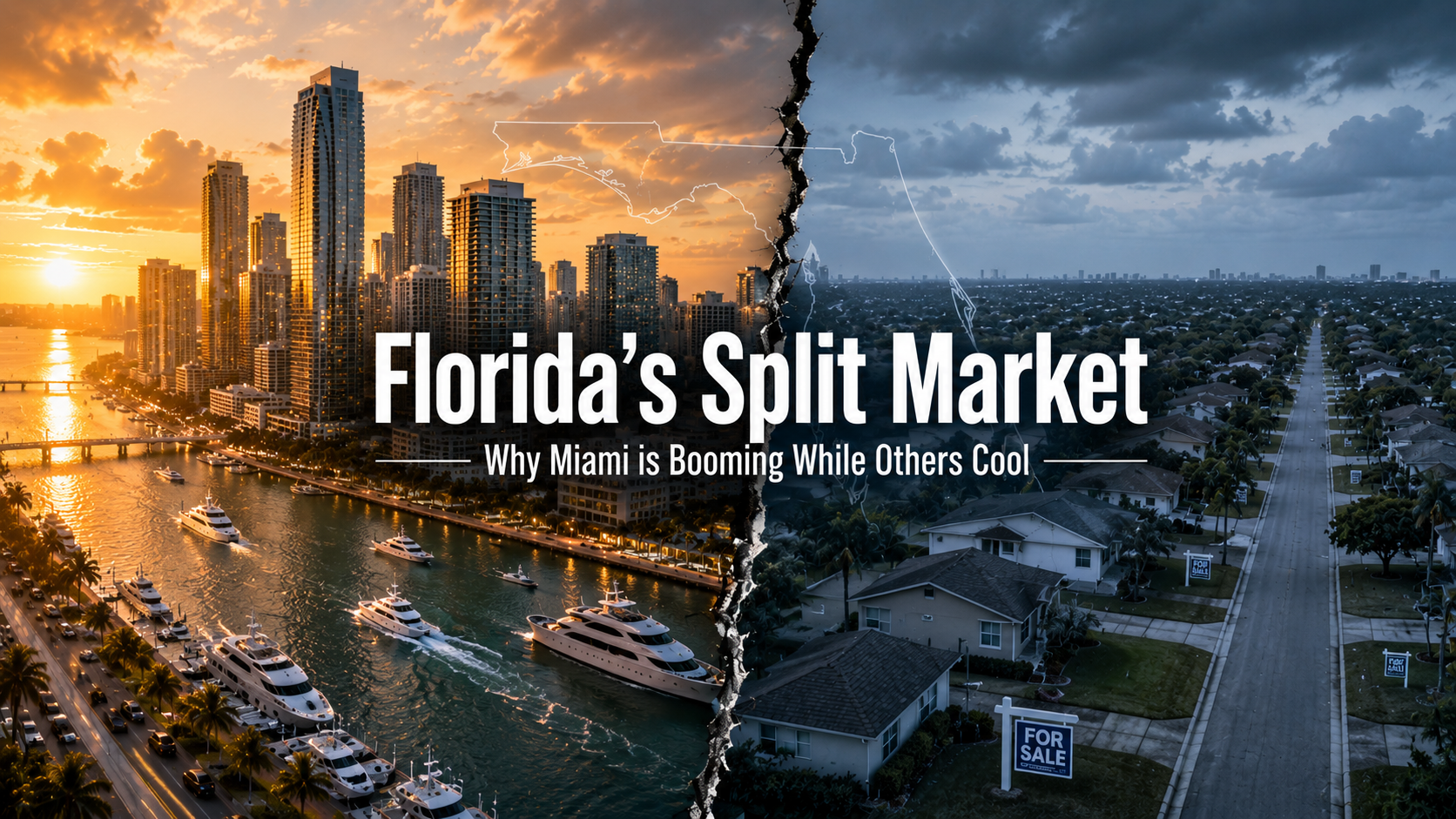

If you’ve been following the Florida real estate market in 2026, you’ve probably noticed something unusual — the headlines seem to contradict each other. One article says Florida is booming. Another says prices are crashing. The truth? Both are right — just in different zip codes.
Florida isn’t one market. It never really was. But in 2026, the gap between cities that are thriving and those that are cooling has become impossible to ignore. And nowhere is this contrast sharper than the story of Miami vs. the rest of the state.
Let’s break it all down.
🗺️ The Big Picture: Florida’s “Split Market” Explained
Statewide home prices in Florida are forecast to grow by just 2.2% in 2026, and the regional divergence is expected to continue — with growth hotspots like Miami projected to see positive price gains between 1.1% and 3.7%, while correction zones on the Gulf Coast like Cape Coral and North Port could experience price declines of 10.2% and 8.9% respectively.
That’s not a small gap. That’s a tale of two completely different markets operating under the same state flag.
So what’s driving this split? The answer lies in four key forces: international capital, luxury demand, inventory surges, and the lingering scars of the pandemic-era boom.
🏖️ Why Miami Is Still Winning
1. International Money Keeps Flowing In
Miami has always been a global city, but in 2026, that status is paying dividends that other Florida markets simply cannot replicate.
Demand in Greater Miami is underpinned by migration from higher-tax states, international capital flows, and the city’s growing role as a financial, tech, and lifestyle hub. Florida’s lack of state income tax, strong connectivity to Latin America and Europe, and year-round climate continue to attract both domestic and foreign buyers — giving Miami’s property market a combination of income potential and global liquidity that few U.S. cities can match.
When buyers can come from New York, São Paulo, and London simultaneously, the demand floor never really collapses.
2. The Luxury Segment is on Fire
While the overall volume of transactions has moderated, the ultra-high-end segment of Miami’s market is thriving in a league of its own.
Sales in the $1 million+ category surged more than 21% year-over-year in January 2026, and South Florida recorded its highest-ever number of $20 million-plus condo transactions in 2025 — cementing the region as the undisputed capital for ultra-luxury living.
A significant portion of sales in Miami are cash transactions — 37.1% in July 2025 — well above the national average, driven by the high number of international buyers and people relocating from more expensive areas.
When buyers don’t need a mortgage, rising interest rates simply don’t deter them.
3. Miami’s Neighborhoods Are Absorbing Demand Consistently
Brickell — the “Wall Street of the South” — continues to absorb new inventory as corporate relocations show no sign of slowing, while Coral Gables and Coconut Grove remain top choices for families seeking historic charm and long-term appreciation.
In Miami-Dade County, 68% of local markets saw positive sales numbers, with areas like Cutler Bay posting 17% growth and Miami Beach showing a 16% jump — demonstrating that both first-time homebuyers and luxury investors remain active across the spectrum.
4. Still Relatively Affordable on a Global Scale
Here’s a perspective shift that surprises many buyers: Miami is actually considered a relative value on the world stage.
Despite years of price growth, Miami still compares favorably with other international gateway cities on a price-per-square-meter basis — one million dollars buys significantly more prime residential space in Miami than in markets such as Monaco, New York, or London.
For global investors comparing options, Miami is still a bargain.
🌊 Where Florida Is Cooling — And Why
The Gulf Coast Correction: Cape Coral, North Port & Tampa
The story on Florida’s Gulf Coast is very different, and it’s important to understand why without panic.
The Gulf Coast regions are expected to experience the most significant price adjustments in 2026 — Cape Coral faces a projected decline of 10.2%, followed by North Port at 8.9%, and Tampa at 3.6%. These areas saw substantial price increases previously, and a correction was not entirely unexpected.
As of March 2026, Cape Coral home prices were already down 4.8% compared to the previous year, with homes selling at a median price of $351K and sitting on the market for an average of 69 days.
The causes are well-documented:
Cape Coral’s market cooled due to a combination of overinflated pandemic gains, high mortgage rates, rising inventory, and soaring insurance costs — buyers now have more options and leverage, with inventory levels above six months — a clear sign of a buyer’s market.
North Port has seen an even more dramatic long-term correction — typical August 2025 home sales prices were 20% lower than three years prior, reflecting how dramatically the pandemic-era boom overstretched valuations in these markets.
This Is a Correction, Not a Crash
This distinction matters enormously — both for sellers managing expectations and buyers eyeing opportunity.
Industry experts describe what’s happening as a correction, not a crash — prices have softened and may dip slightly or flatten out, but a massive drop is unlikely due to ongoing demand and population growth. As of early 2026, Cape Coral represents a buyer’s market where those thinking about buying have the time and leverage to negotiate — a dynamic that hasn’t existed for years.
For patient buyers who were priced out during the boom, this is actually the window they’ve been waiting for.
📊 The Numbers at a Glance: Miami vs. Gulf Coast 2026
| Market | Price Trend (2026) | Market Type | Key Driver |
|---|---|---|---|
| Miami | +1.1% to +3.7% | Seller-leaning | International buyers, luxury demand |
| Fort Lauderdale | Stable / Slight growth | Balanced | Constrained inventory |
| Tampa | -3.6% | Buyer | Post-boom correction |
| North Port | -8.9% | Strong buyer | Inventory surplus |
| Cape Coral | -10.2% | Strong buyer | Insurance costs, excess supply |
🤔 What Does This Mean for You?
If You’re a Buyer:
The Gulf Coast markets — Cape Coral, North Port, and parts of Tampa — are offering negotiating power that hasn’t existed since pre-2020. If you’re not tied to a specific city, this correction window is significant. In Miami, you’ll face stiffer competition but are buying into a market with more structural resilience.
If You’re a Seller:
Pricing strategy is everything right now. In Miami, well-positioned properties — especially luxury and waterfront — are still commanding strong prices. On the Gulf Coast, sellers who resist pricing adjustments are watching their homes sit. Competitive pricing and seller concessions (rate buydowns, closing cost contributions) are becoming table stakes.
If You’re an Investor:
The Florida housing market in 2025–2026 rewards strategic insight and localized knowledge — whether you are a buyer, seller, or investor, the key to success is data-driven decision-making, up-to-date market analysis, and adaptation to current pricing and affordability conditions.
The split market is creating genuine arbitrage opportunities — distressed Gulf Coast inventory for cash-flow investors, and Miami luxury for appreciation and global liquidity plays.
🔮 What’s Next for Florida Real Estate?
Nationally, existing-home sales are forecast to rise 14% in 2026 as mortgage rates ease toward 6% and more homes come to market — trends that could have an outsized positive impact in fast-growing states like Florida.
A cautiously optimistic forecast has the typical 30-year fixed mortgage rate at 6% for much of 2026 — and as rates ease, affordability improves, which is expected to draw more buyers back into the market, particularly first-time buyers who have been largely sidelined.
The macro tailwinds are real. Lower rates will lift all boats — but Miami is already sailing while parts of the Gulf Coast are still finding their sea legs.
🏁 Final Takeaway
Florida’s real estate market in 2026 isn’t booming or busting — it’s bifurcating. Miami’s global identity, luxury demand, and cash-rich buyer pool have insulated it from the broader correction. Meanwhile, Gulf Coast markets like Cape Coral and North Port are still digesting the excess of the pandemic boom, offering buyers rare leverage in what was an impossibly competitive market just two years ago.
The smart move — whether you’re buying, selling, or investing — is to stop thinking about “Florida real estate” as one thing. Your zip code is your market. And right now, the zip codes are telling very different stories.
📌 Stay ahead of the Florida real estate market. Bookmark this blog for monthly updates and city-by-city breakdowns.