


The Baseline Has Shifted. Permanently.
There was a time — not long ago — when a smart thermostat was a selling point.
Agents would walk buyers through a listing, gesture toward the Nest on the wall, and watch eyebrows rise with impressed curiosity. A home with app-controlled lighting? That was cutting edge. A property with a connected security system? Practically futuristic.
That time is gone.
In 2026, if you’re listing a luxury property in South Florida — whether it’s a $4 million waterfront estate in Miami Beach, a penthouse in Sunny Isles Beach, or a high-end single-family home in Naples or Palm Beach — and you don’t have integrated smart home technology, you don’t have a luxury home. You have an expensive one.
The expectation has fundamentally changed. And for buyers, sellers, developers, and agents operating in Florida’s high-end market, understanding exactly what that means — and what today’s affluent buyer actually demands — is no longer optional either.
Why Florida Is Ground Zero for Smart Home Adoption
Florida’s luxury real estate market has always been a special case. Unlike primary residence markets in the Northeast or Midwest, Florida’s luxury segment is dominated by second-home buyers, seasonal residents, international investors, and high-net-worth individuals who regularly divide their time between multiple properties across multiple countries.
This changes everything about what a home needs to do.
When a buyer spends four months in Miami Beach and eight months split between New York, London, and the Hamptons, they need their Florida property to essentially run itself. The air conditioning must maintain optimal humidity levels in their absence. The security system must provide live visual confirmation at any moment, from any device, anywhere on earth. The lighting and water systems must be manageable remotely. If a pipe bursts or a window is left open during a storm, the owner needs to know — and be able to act — regardless of whether they’re in the same zip code or on a different continent.
This isn’t a luxury preference. It’s a functional necessity for the way Florida’s wealthiest buyers actually live. And the technology has finally caught up completely with the demand.
What “Smart Home” Actually Means in 2026 — And What It Doesn’t
Before diving into what today’s buyers expect, it’s worth clarifying a common misconception.
Smart home technology in luxury real estate is not a collection of clever gadgets. It is not a Ring doorbell and a voice-activated speaker. It is not even a suite of individually downloaded apps that each control one system.
In the luxury tier, smart home technology means full systems integration — a single, unified platform that connects every mechanical and environmental system in the property and allows seamless control from one interface, locally or remotely.
The key word is seamless. The moment a wealthy buyer has to toggle between four different apps to control their home, the experience has failed. The ultra-luxury market demands the same frictionless, hotel-grade operational standard that these buyers experience in the world’s finest properties — and they expect their home to meet it.
Here’s what that actually looks like in 2026’s top Florida properties.
The Must-Have Systems: What Florida Luxury Buyers Expect
1. Unified Control Platforms
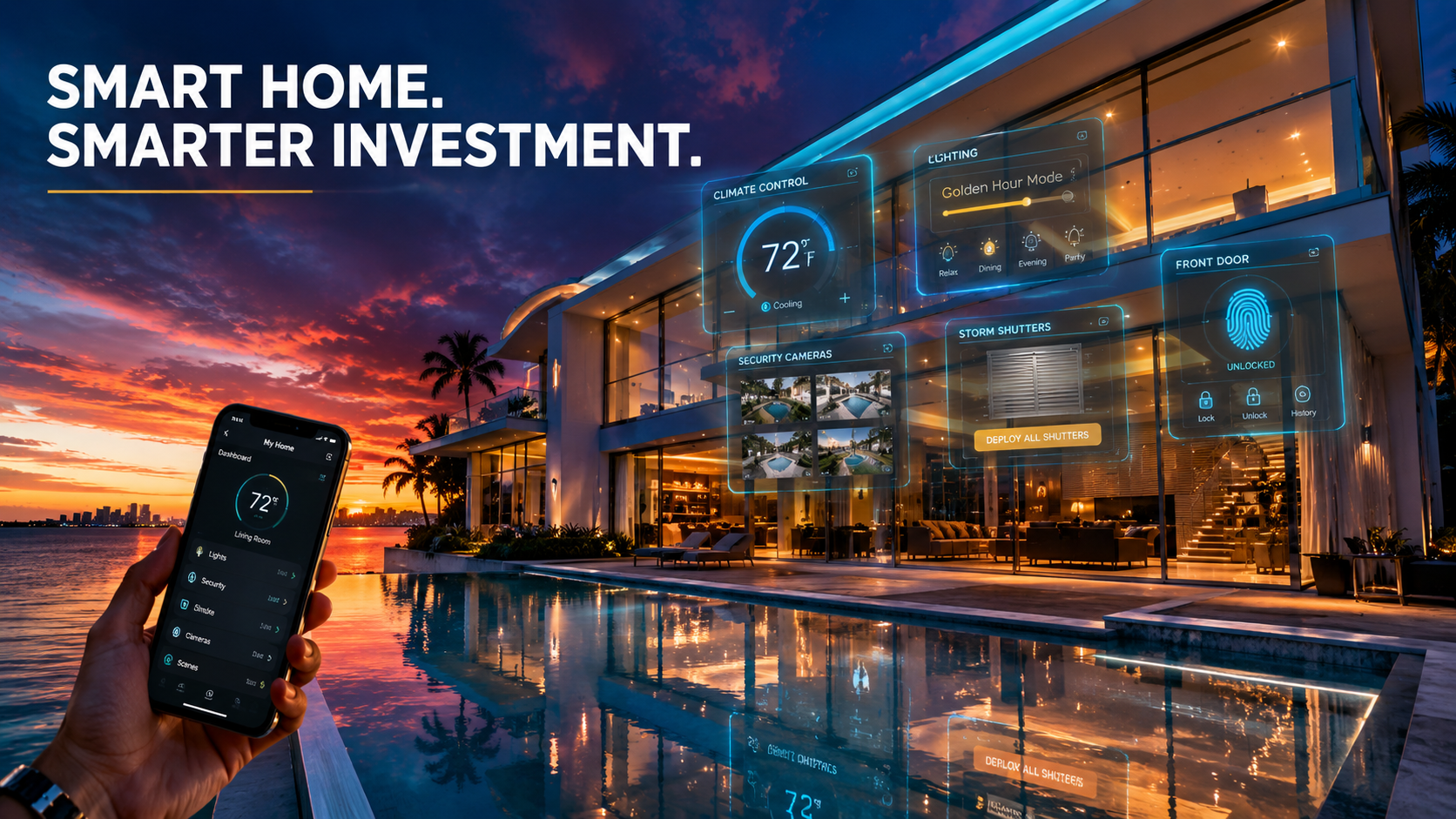
The foundation of any true luxury smart home is a single-platform control system that ties together lighting, HVAC, audio-visual, motorized shading, security, and access control under one interface. Leading platforms like Crestron, Savant, and Control4 have become the industry standard in South Florida’s high-end new construction and premium renovations.
The difference between a $3 million home and a $6 million home increasingly comes down to whether this integration exists — and how elegantly it performs.
2. Climate Intelligence That Thinks Ahead
Florida’s climate is unforgiving. Humidity, heat, and the threat of mold in unoccupied properties are not abstract concerns — they cause real, expensive damage. Intelligent HVAC systems in luxury homes now go far beyond programmable schedules. They monitor interior humidity in real time, adjust independently based on outdoor conditions, detect when windows or doors are left open, and alert owners remotely when conditions deviate from safe parameters.
For seasonal residents who leave their properties for months at a time, this isn’t a nice-to-have. A single mold remediation event in a luxury home can cost $50,000 to $200,000 or more. The technology that prevents it costs a fraction of that.
3. Advanced Security and Remote Access
In Miami Beach, Boca Raton, and Palm Beach, security systems have evolved far beyond cameras and alarm codes. Today’s luxury standard includes AI-powered camera systems that distinguish between a raccoon on the driveway and an unauthorized person at the front door. Facial recognition access. Perimeter detection with immediate alerts. Integrated panic room technology. And complete remote management — allowing owners to grant and revoke access for housekeepers, contractors, and guests with time-specific digital keys, from anywhere in the world.
The lock-and-leave lifestyle that defines Florida’s luxury second-home market is only truly possible when this infrastructure exists.
4. Circadian and Wellness Lighting
This is one of the fastest-growing categories in luxury real estate technology — and one that many buyers aren’t yet aware of until they experience it firsthand.
Circadian lighting systems automatically shift the color temperature and intensity of interior lighting throughout the day to mirror natural sunlight cycles. Warm, amber tones in the morning and evening. Bright, energizing light during peak afternoon hours. Dimming gradually as evening approaches.
The science behind this is well-established: proper light exposure directly impacts sleep quality, energy levels, and cognitive performance. In a market where buyers are paying $5, $10, or $30 million for a home, the idea that their living environment should actively support their wellbeing — rather than simply illuminate it — has strong and growing appeal.
5. Storm-Ready Smart Scenes
Florida buyers know what storm season means. The most sophisticated luxury properties now feature what developers and integrators call “storm-ready scenes” — a single-command automation that simultaneously lowers motorized hurricane shutters, locks all entry points, sets HVAC to a holding humidity mode, activates backup generator protocols, and sends a status confirmation to the owner’s device.
What used to take 45 minutes of manual preparation can now happen in under 90 seconds, triggered remotely from a phone screen before a storm even makes landfall. In a state that averages over a dozen named storms per season, this isn’t a gimmick. It’s infrastructure.
6. Energy Management and Solar Integration
As Florida energy costs continue to rise and sustainability becomes a genuine luxury value — not just a marketing buzzword — intelligent energy management has become a differentiating feature in high-end listings. Smart panels that monitor real-time energy consumption by system and room. Solar integration with battery backup. EV charging stations with load-balancing capability. These features are now present in the most competitive luxury listings across Miami, Naples, and the Palm Beaches — and buyers who’ve owned smart properties before increasingly expect them.
The Connectivity Foundation Everyone Overlooks
Here’s something that separates a truly smart luxury home from a property that merely has smart devices installed: the underlying infrastructure.
In Miami Beach specifically — with its thick concrete construction, extensive floor-to-ceiling glazing, and dense neighboring networks — wireless performance alone is rarely sufficient for a home that demands seamless operation of video, security streams, multi-room audio, and environmental controls simultaneously.
The hidden indicator of a properly executed smart home is what you can’t easily see: a professionally designed structured wiring plan. Hardwired ethernet and fiber runs. Enterprise-grade wireless access points. A clean, ventilated equipment rack. A documented network layout that any future integrator can immediately understand and service.
Agents and buyers who know what to look for ask to see the AV closet and the network panel. What they find tells them almost everything they need to know about how seriously the technology was implemented — and how much headache they’ll have maintaining it.
What This Means for Sellers: Technology Is Now a Price Multiplier
For sellers in Florida’s luxury market, smart home integration has moved from a “nice addition” to a genuine pricing variable.
Properties with fully integrated systems, documented and operational at showing, consistently command premium pricing and shorter days on market. Properties with dated or absent technology are increasingly finding themselves in a competitive disadvantage — particularly against new construction that launches with these systems as standard.
The calculation for sellers considering pre-listing upgrades is no longer just cosmetic. A full smart home integration package from a reputable installer — covering climate, security, lighting, audio-visual, and access — typically runs between $80,000 and $250,000 depending on property size and complexity. In the luxury segment, that investment routinely adds $300,000 to $800,000 in perceived and actual value, while dramatically improving the speed and certainty of the sale.
The return on investment is measurable. And savvy sellers in South Florida are running those numbers before they list.
What This Means for Buyers: The Questions You Must Ask
If you’re purchasing a luxury property in Florida in 2026, smart home due diligence needs to be part of your evaluation process — not an afterthought after you’ve already fallen in love with the ocean view.
Before making an offer, ask these questions:
What platform does the home run on? Closed, proprietary systems can be expensive and restrictive to expand. Open-architecture platforms like Control4 or Savant offer far more flexibility.
Has the system been professionally documented? A legitimate smart home installation comes with full documentation of all wiring runs, device configurations, and programming logic. If the seller can’t produce this, factor in the cost of an audit.
What is the network infrastructure? Ask about hardwired ethernet, the router and access point setup, and who currently manages the network.
Are all systems operational and demonstrable during showing? If a listing claims smart home features but the agent can’t demonstrate them live during your visit, assume they don’t function as described.
What are the ongoing service costs? High-end smart home systems typically involve annual service contracts. Understand what’s covered and what isn’t before you close.
The New Definition of Florida Luxury
Luxury in real estate has always been a moving target. What defined it in 2005 — a gourmet kitchen, a steam shower, a three-car garage — became the baseline expectation a decade later.
The same shift is happening right now with technology. What felt cutting-edge in 2020 is the minimum viable product in 2026. And the properties already embracing the next generation of smart home capability — AI-assisted environmental learning, biometric security, wellness-centered design, fully autonomous storm response — are defining what Florida luxury will look like for the next decade.
For buyers, the message is clear: don’t just tour the finishes. Audit the infrastructure. The most valuable thing in a Florida luxury home may be completely invisible to the naked eye.
For sellers, it’s equally straightforward: the technology gap between your property and the competition is now a pricing gap. Close it before you list — or accept the consequences on your bottom line.
And for everyone in the market: smart home technology in Florida luxury real estate is no longer a category you opt into. It’s the new price of admission.
Thinking about buying or selling a luxury property in Florida? Share this post with someone navigating the market — the details here could be worth hundreds of thousands of dollars in their next transaction.