


Let’s be honest—when you see your electric bill during a Tampa Bay summer, your first thought isn’t about the environment. It’s about your wallet. But here’s the good news: the upgrades that slash your energy bills also happen to be the ones that boost your home’s value. It’s the rare home improvement that pays you twice.
If you’re wondering whether energy-efficient upgrades are worth it, the answer is yes—if you know which ones actually deliver returns. Let me walk you through the three retrofits that make the biggest financial impact for Florida homeowners.
Why Energy Efficiency Matters More in Florida
Before we dive into specific upgrades, you need to understand why this matters so much here. Florida isn’t like most places. Our air conditioners run nearly year-round. According to recent data, the average Tampa Bay home uses about 1,142 kilowatt-hours per month—significantly higher than the national average of 881 kWh. That translates to roughly 60% of your utility bill going toward cooling costs alone.
When your HVAC system is working overtime for nine months a year, even small efficiency improvements add up fast. But it’s not just about monthly savings anymore. With home insurance rates climbing and buyers getting pickier about long-term costs, energy-efficient homes are commanding premium prices. Recent studies show that homes with efficiency upgrades sell for 4% to 7% more than comparable properties without them.
Solar Panels: The Heavy Hitter
Let me start with the elephant in the room. Solar panels have the highest upfront cost, but they also deliver the most dramatic returns for Florida homeowners.
The Real Numbers
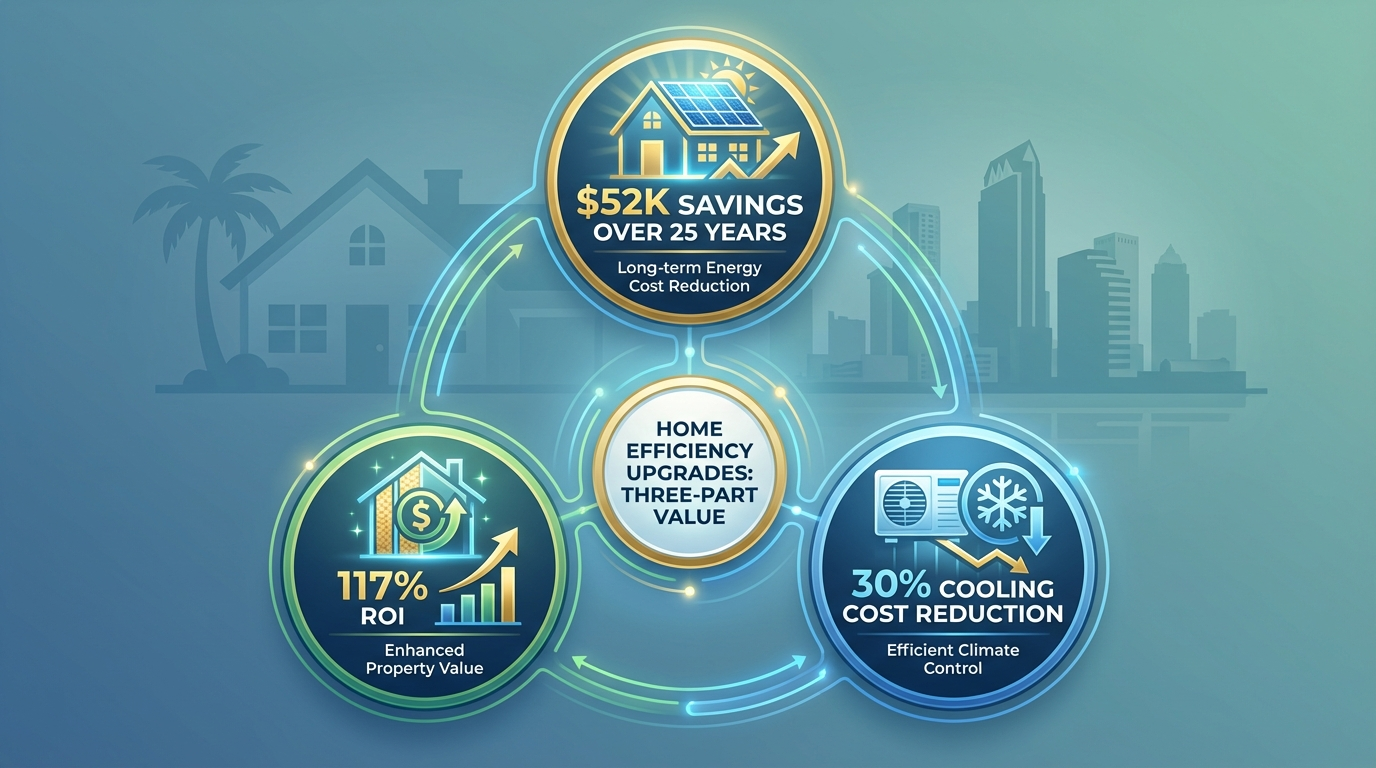
As of early 2026, the average solar installation in Florida costs about $31,700 for a 14.4 kW system before incentives. That sounds intimidating until you factor in the 30% federal tax credit, which drops your actual cost to around $22,200. For most Tampa Bay homeowners, that system will save approximately $52,000 over 25 years.
Break that down, and you’re looking at an 11-year payback period—not bad when you consider that solar panels typically last 30 years or more. After year 11, you’re essentially getting free electricity while your neighbors’ rates keep climbing.
Home Value Impact
Here’s where it gets interesting. Multiple studies confirm that solar panels increase home value by roughly 4% to 7%. For a $400,000 home in Seminole or Clearwater, that’s an additional $16,000 to $28,000 in resale value. Even better, Florida offers a property tax exemption for solar installations, meaning you get the value boost without the tax increase.
One Central Florida study found that homes with solar sold for about 4.1% more than comparable homes without it. Buyers aren’t just paying for the panels—they’re paying for predictable energy costs. When utility rates are volatile, that peace of mind has real value.
The Financing Reality
Most people don’t pay cash for solar. If you’re financing, your monthly loan payment should be roughly equal to or less than your current electric bill. Some homeowners see immediate positive cash flow, especially if they’re currently paying $200+ monthly to the utility company.
Just avoid solar leases and power purchase agreements if you can. While they sound appealing with zero-down options, you don’t get the tax credit, and they complicate home sales. Cash purchases or solar loans deliver far better returns—we’re talking $20,000 to $50,000 more in lifetime value.
What to Watch For
Florida’s insurance market is tricky right now. Make sure your installer meets wind mitigation standards and get documentation. Some insurance companies will raise your premium to cover the added replacement cost of the panels, but the increase is usually modest—around $50 to $100 annually.
High-Efficiency HVAC: The Workhorse Upgrade
If solar feels like too big a leap, your HVAC system is the next best target. In Florida’s climate, this isn’t optional equipment—it’s life support. The question is whether you’re running an energy-guzzling dinosaur or a modern, efficient system.
The Cost-Benefit Breakdown
Replacing an old HVAC system in Florida typically runs $7,000 to $14,000, depending on your home size and system type. That’s a wide range, so let’s get specific. A typical 2,000-square-foot home needs about an $8,000 to $12,000 investment for a quality high-efficiency system.
Here’s what makes it worth it: upgrading from an old SEER 10-13 system to a modern SEER2 17-20 unit can cut your cooling costs by 18% to 30%. For a home spending $200 monthly on cooling, that’s $430 to $720 in annual savings. Your payback period typically hits around eight to twelve years.
The 2026 Sweet Spot
Right now—and I mean right now in early 2026—there’s a unique window of opportunity. HVAC manufacturers are clearing out R-410A refrigerant systems at steep discounts because the industry has transitioned to R-454B. You can find premium inverter systems discounted 20% to 30%.
Here’s the kicker: R-410A systems are still completely functional for their expected 15+ year lifespan. You’re not buying obsolete equipment—you’re getting top-tier technology at clearance prices.
Stack the Incentives
Federal tax credits through Section 25C offer up to $2,000 for qualifying heat pump installations. Local utility companies add their own rebates—TECO offers $500 to $1,000 for high-efficiency heat pumps, while Duke Energy provides $300 to $600 depending on the system specs.
For a $10,000 HVAC replacement, you could stack a $2,000 federal credit with a $600 utility rebate, dropping your net cost to $7,400. Add in your annual energy savings of $500 to $700, and you’re looking at a 10 to 12-year payback.
What Actually Matters
Don’t just chase SEER ratings. Look for variable-speed compressors and smart controls. These features adapt to your home’s actual cooling needs instead of running full blast all the time. The result is better humidity control, fewer temperature swings, and less wear on the equipment.
One thing that surprises people is how much proper installation matters. An Energy Star study found that proper duct sealing alone improves efficiency by 20%. If your installer isn’t doing load calculations (Manual J) and checking duct integrity, you’re leaving money on the table.
Attic Insulation: The Unsexy Money-Maker
Nobody gets excited about attic insulation. It’s not Instagram-worthy. But in terms of bang-for-buck, it’s hard to beat—especially in Florida where your attic can hit 120°F to 150°F on summer afternoons.
The Investment
Adding or upgrading attic insulation in Florida typically costs $2,000 to $6,000, depending on your home size and chosen material. For a standard 1,500-square-foot attic, blown-in fiberglass to R-38 runs about $1,500 to $3,300. If you want spray foam for maximum performance, expect $5,000 to $8,000.
That might seem like a lot for something you’ll never see, but here’s the reality: proper insulation can cut your cooling costs by 10% to 25%. For a homeowner spending $2,400 annually on cooling, that’s $240 to $600 in yearly savings.
The ROI Numbers
Studies consistently show that attic insulation delivers some of the best returns in home improvement. A 2016 Remodeling Magazine study found that adding fiberglass attic insulation topped their list with a 117% ROI at resale. Yes, you read that right—it more than pays for itself in added home value.
The payback period is typically three to six years through energy savings alone, and spray foam installations can achieve ROI in four to six years despite the higher upfront cost. After that, you’re just banking savings every month.
What Works Best in Florida
Blown-in fiberglass is the most cost-effective option for most existing homes. It fills gaps better than batts and handles irregular spaces well. The recommended R-value for Florida attics is R-30 to R-38, which translates to about 9.5 to 12 inches of material.
Spray foam costs more but delivers superior performance. It creates a complete air barrier, blocks humidity, and can reduce your attic temperature from 120°F+ down to within 10 degrees of your home’s interior. That puts dramatically less stress on your HVAC system.
Cellulose is an eco-friendly middle ground, though it can retain moisture over time in our humid climate. For most Tampa Bay homes, I’d stick with blown-in fiberglass or invest in spray foam if your budget allows.
The Details That Matter
Before adding new insulation, check your existing material. If it looks wet or compressed, you need to address the underlying issues—roof leaks, poor ventilation, or moisture problems. Wet insulation doesn’t just lose effectiveness; it breeds mold.
Also, don’t skip air sealing. Insulation works by trapping air, but if you have gaps around pipes, ducts, and electrical penetrations, you’re paying to cool your attic instead of your home. Professional installers should seal these leaks before blowing in new material.
The Bigger Picture: When to Do What
Not everyone has $30,000 to drop on solar panels tomorrow, and that’s fine. The smart approach is to prioritize based on your situation.
Start with Low-Hanging Fruit
If your HVAC system is over 15 years old and struggling, that’s your first move. An inefficient air conditioner will undermine any other efficiency upgrades. Similarly, if your attic insulation is thin or damaged, fix that before considering solar. You’ll get better returns from solar panels when your home isn’t bleeding energy.
Consider Your Timeline
Planning to sell in two to three years? Focus on upgrades with immediate impact on home value—fresh HVAC systems and attic insulation both score well with buyers and appraisers. Staying put for a decade? Solar becomes much more attractive because you’ll capture more of those long-term savings.
Stack Your Strategies
The most cost-effective approach is to combine upgrades. Install solar panels when you’re already replacing your roof. Add attic insulation when you’re upgrading your HVAC system so the contractor can access everything at once. Bundling work saves on labor costs and creates a more comprehensive efficiency package.
Don’t Forget the Details
Big-ticket items get the attention, but don’t overlook basics like programmable thermostats, LED lighting, and regular HVAC maintenance. These might not deliver the same dramatic returns, but they’re cheap, easy, and they add up over time.
The Bottom Line for Tampa Bay Homeowners
Energy-efficient upgrades aren’t just good for the planet—they’re good for your finances. Solar panels, high-efficiency HVAC systems, and proper attic insulation consistently deliver strong returns through lower utility bills and increased home values.
The key is choosing the right upgrades for your home and timeline. A well-insulated home with an efficient HVAC system and solar panels can cut energy costs by 50% or more while commanding a premium at resale. Even better, you get to enjoy lower bills and better comfort for years before you ever think about selling.
If you’re considering selling your Tampa Bay home or looking to invest in properties with these upgrades already in place, the team at Grace Realty can help you understand which improvements deliver the best returns in our local market. Energy efficiency isn’t just a trend—it’s becoming table stakes for competitive home values in Florida.
The climate isn’t getting any cooler, and energy costs aren’t headed down. The question isn’t whether to make these upgrades—it’s which ones to prioritize and when to start. For most Tampa Bay homeowners, that answer is now.