
There’s a conversation happening in Tampa Bay real estate that most people are quietly avoiding.
Not about interest rates. Not about inventory. Not about whether now is a good time to buy.
It’s about water.
Specifically — the kind that doesn’t knock before it enters your home.
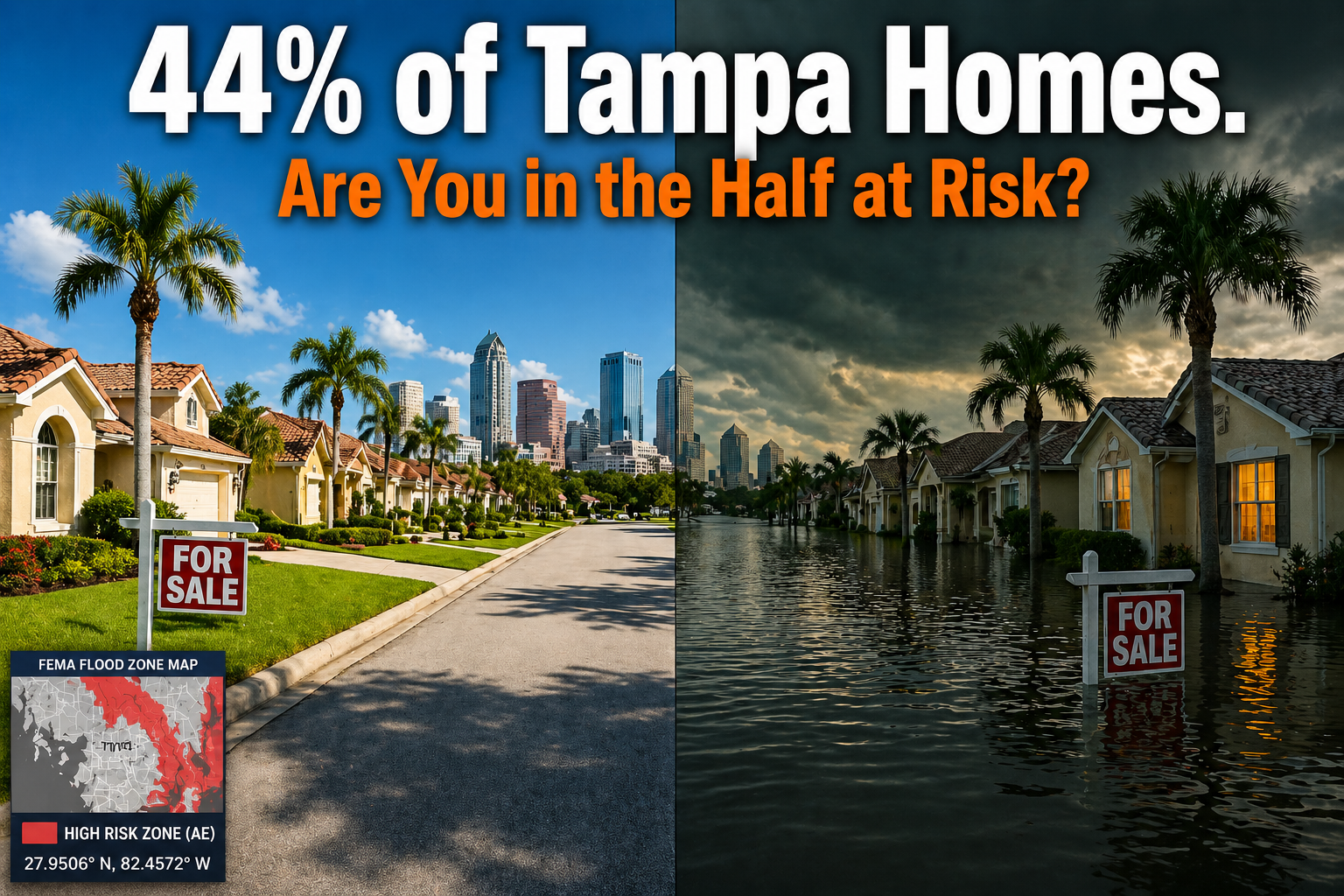
According to data from First Street Foundation, 44% of all properties in Tampa are likely to be severely affected by flooding over the next 30 years, and flood risk is increasing faster than the national average. That’s nearly half the city. And yet, when most buyers sit across from a listing agent, flood risk rarely makes it into the first five minutes of conversation.
That needs to change.
Why Tampa Bay Is Uniquely Vulnerable
Tampa Bay isn’t just another coastal Florida city. It sits in a geography that makes it one of the most flood-exposed metros in the entire United States.
Of 269 census tracts in Tampa, there are 108 where more than half of all buildings have significant risk from storm surge, high tide flooding, surface flooding, and riverine flooding. That’s not a fringe risk. That’s a structural reality baked into the land itself.
Tampa Bay sits at the convergence of multiple flood risk factors — tropical storms, storm surge, heavy rainfall, and an aging stormwater infrastructure. The bay’s funnel shape means storm surge from a major hurricane can push water inland far faster and deeper than most residents expect.
Here’s a number that should stop anyone mid-scroll: buildings at risk in Tampa average about a 63% chance of experiencing a flood roughly 2.2 feet deep over the next 30 years.
That’s not a worst-case scenario. That’s the average.
And Tampa Bay hasn’t taken a direct hurricane hit since 1921. A worst-case Category 5 hurricane scenario could destroy half a million buildings and displace millions of people. The region is, in many ways, living on borrowed time.
The Insurance Gap Nobody Wants to Talk About
Here’s where it gets financially dangerous.
Standard homeowners insurance does not cover flooding. Flood damage caused by rising water — whether from a hurricane storm surge, an overflowing river, or heavy rain pooling on the ground — is excluded from nearly every standard property insurance policy.
Most homebuyers don’t realize this until after closing. Sometimes not until after a storm.
Tampa Bay’s configuration creates significant storm surge risk, with flood insurance costs ranging from $700–$1,800 annually for moderate-risk zones and $2,500–$10,000 or more for high-risk coastal areas.
For buyers stretching their budget to afford a home at today’s prices, a $5,000-a-year flood insurance bill is the kind of surprise that turns a dream home into a financial burden.
And the problem is accelerating. Since 2020, climate disasters have cost Florida roughly $237 billion, according to the National Centers for Environmental Information. Hurricanes Helene and Milton alone combined for over $100 billion in damages. These losses are reshaping what insurance looks like in Florida — and what it costs.
FEMA’s Risk Rating 2.0: The New Reality for Tampa Homeowners
In 2021, FEMA quietly changed the game.
FEMA’s Risk Rating 2.0 revolutionized how flood insurance is priced, creating more accurate premiums based on individual property characteristics rather than broad zone designations. It calculates risk for your specific home by considering distance from water, elevation, first-floor height, foundation type, and construction year.
This means two homes on the same street can have wildly different flood insurance costs. It also means many homeowners who previously enjoyed low premiums because of their flood zone designation are now seeing their real risk — and their real cost — for the first time.
Increases for existing NFIP policies phase in under the federal 18% annual cap until the full risk rate is reached. Which means if your home is underpriced for risk today, your premiums will keep climbing every single year.
The one silver lining? Tampa participates in FEMA’s Community Rating System and is currently rated a Class 5 community, providing a 25% discount on flood insurance premiums in flood zones and a 10% discount on policies outside the flood zone. St. Petersburg and Clearwater share the same Class 5 rating. That discount is real money — but it only matters if you actually have coverage.
What Buyers Need to Ask Before They Sign Anything
If you are buying a home in Tampa Bay right now, these are non-negotiable questions:
What is the FEMA flood zone designation for this specific property? There is a difference between Zone X, Zone AE, and Zone VE — and that difference is thousands of dollars a year.
Has this property ever flooded? Sellers in Florida are legally required to disclose known flood history, but “never flooded” is not the same as “not at risk.”
What will flood insurance actually cost me — not the previous owner, but me under Risk Rating 2.0? Get a quote before you make an offer. Not after.
Is the elevation certificate current? Especially for older homes, an outdated elevation certificate can mean you are paying too much — or being misclassified entirely.
What about 30-year climate projections? Forecasts for 2040 indicate that much of the Tampa Bay area will be three feet underwater due to sea level rise, which is expected to make storms and storm surge more dangerous and destructive.. That’s within the life of a 30-year mortgage taken out today.
The Conversation Real Estate Agents Should Be Leading
Here’s the uncomfortable truth.
Flood risk is a material fact. It affects the long-term value of a home. It affects carrying costs. It affects insurability. It affects the ability to resell.
And in a market where buyers are being told this is their moment — inventory is up, sellers are willing to negotiate, prices have moderated — flood risk is the variable that could quietly erase every gain.
The agents and brokers who are building trust right now are the ones having this conversation proactively. Not defensively. Not in the fine print. Up front, honestly, and with data.
Because here’s what the data says:
Nearly half of Tampa Bay properties face severe long-term flood exposure. Standard homeowners insurance covers none of it. Climate risk is increasing faster in Tampa than the national average. And most buyers are walking into one of the biggest purchases of their lives without ever being told.
The water isn’t waiting for the right moment to show up. The question is whether the conversation about it will.
Buying a home in Tampa Bay is still one of the best long-term decisions millions of people make every year. The region has extraordinary economic momentum, strong population growth, and a quality of life that is genuinely hard to match.
But informed buyers make better decisions. And better decisions lead to better outcomes — for homeowners, for agents, and for the long-term health of this market.
Ask the flood questions. Get the quotes. Check the maps.
And find an agent who isn’t afraid to tell you what you actually need to know.